Unraveling the World of Kubernetes Orchestration
Tiempo estimado de lectura: 10 minutos
Puntos Clave
- Kubernetes orchestration automates deployment, scaling, and management of containerized applications across clusters.
- The declarative desired-state model and continuous reconciliation are the heart of Kubernetes orchestration.
- Control plane nodes orchestrate cluster-wide operations, while worker nodes execute containers.
- Kubernetes offers robust features for scheduling, automated deployment, scaling, and self-healing.
- Its architecture abstracts infrastructure complexity and is widely adopted for cloud-native applications.
Tabla de Contenidos
Hello and welcome to our newest exploration of the tech world. This week, we delve deep into a new and thrilling subject, Kubernetes orchestration. It’s the latest trend sweeping the tech news, and we’re here to decode it for you.
Kubernetes orchestration, according to Mirantis, Openlogic and IBM, forms the backbone of deploying, managing, and scaling containerized applications. This process essentially automates the process of managing applications, ensuring they are healthy and available across clusters of machines.
So without further ado, let’s dive in!
1. The Definition of Kubernetes Orchestration
Let’s begin with the very building block of this vast topic – understanding what Kubernetes and orchestration mean.
Kubernetes, or K8s, is an open-source platform used for managing containerized workloads and services using declarative configuration and automated processes source. It originated from the brilliant minds of Google engineers but is now under the aegis of the Cloud Native Computing Foundation (CNCF) source.
Now, you might ask, ‘What does orchestration mean?’ In the context of containers, orchestration represents the automatic deployment, management, scaling, and lifecycle management of containerized applications across clusters source.
At present, Kubernetes is the dominant player in the field of container orchestration, effectively serving as the go-to layer for managing cloud-native applications in data centers, public clouds, and edge environments source.
However, Kubernetes performs orchestration differently from the traditional definition. Traditional orchestration follows a sequence: first, do A, then B, then C. Kubernetes, on the other hand, operates through independent, composable control loops to steer the current state to a desired state. Despite this nuanced difference, industry insiders continue to refer to Kubernetes as a container orchestration platform source.
2. The Orchestrative Model of Kubernetes: Desired State and Reconciliation
At the core of Kubernetes orchestration, you’ll find a heart beating to the rhythm of a declarative desired-state model source.
Here’s how it works –
Users state their application requirements, including the number of replicas needed, image versions, resources, networking, and others in configuration manifests (in YAML/JSON format) or via APIs source. These input parameters set the stage for the Kubernetes subsequent operations.
The Kubernetes control plane then continuously compares the actual state of the cluster with the desired state. Based on this comparison, it performs various actions to align them, such as creating or deleting pods, rescheduling workloads, restarting containers, etc. source.
Three key features underline this model.
- Declarative configuration: You provide the ‘what’ for Kubernetes, while Kubernetes figures out the ‘how’. With declarative configuration, Kubernetes determines placement, rollout, restarts, and scaling steps independently source.
- Continuous reconciliation loops: Multiple controllers diligently watch the cluster state and reconcile any deviations, forming the orchestrative engine of Kubernetes source.
- Abstraction of infrastructure: Kubernetes simplifies application deployment across diverse machines and environments by providing a consistent API and object model. It effectively hides the underlying details of compute, networking, and storage source.
3. The Architecture of Kubernetes Orchestration
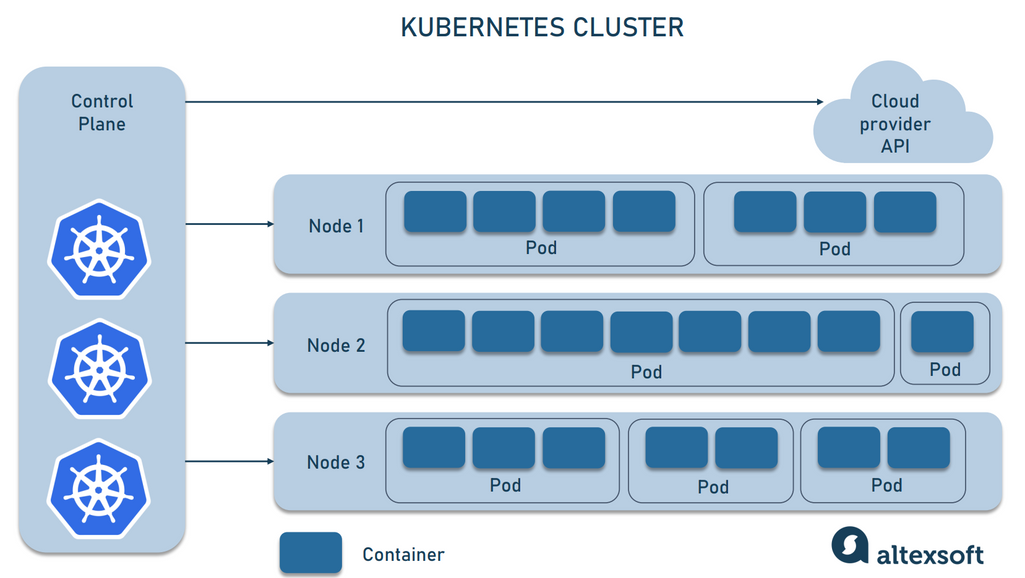
Kubernetes orchestration operates on an architectural framework comprising control plane nodes and worker nodes source.
Control plane (Orchestration Brain)
The brain of Kubernetes orchestration lies in the control plane, which provides the orchestration logic source.
Here’s what it comprises-
- API Server: This acts as a central entry point for all orchestration requests. Clients submit configurations here, and further, controllers/schedulers monitor these configurations source.
- Scheduler: Based on resource availability, constraints, and policies, the Scheduler assigns pods to specific nodes, thereby optimizing resource utilization and performance source.
- Controllers: Controllers are a set of reconciliation processes that ensure the actual state matches the desired, and involves but not limited to, Deployment controller, ReplicaSet controller, Node controller, and Job/cron controllers source.
- Etcd: Often overlooked, the Etcd component is a part of the standard Kubernetes architecture, acting as a backing store for cluster state source.
- Health & Lifecycle Management: Using probes and other status information, the control plane can detect failures and subsequently trigger restarts, rescheduling, or scaling source.
Worker Nodes
The worker nodes are the workforce executing the actual applications through containers source.
Each node employs a container runtime like Docker or containerd and local agents that communicate with the control plane source. Pods present in these nodes are the smallest deployable units consisting of one or more containers that share a network and storage context source. In essence, these worker nodes act upon the decisions made by the control plane, report back their status, and provide resource metrics source.
4. Key Kubernetes Orchestration Functions
Kubernetes orchestration offers a toolbox of capabilities consistently highlighted in tech research.
4.1 Scheduling and Resource Management
The Pod scheduling feature assigns pods to nodes based on criteria like CPU, memory, taints/tolerations, node selectors, affinity/anti-affinity, and other constraints source. Coupled with its Automatic bin packing feature, Kubernetes excellently fills nodes according to resource requirements and policies source. It also provides Batch execution for efficient orchestration of batch workloads across the cluster source.
4.2 Deployment, Rollout, and Rollback
For Automated deployment, Deployments and StatefulSets are used. They manage rollouts of new versions of applications, ensuring the desired number of replicas and sequencing where needed source.
Thanks to the Rolling updates feature, Kubernetes can gradually replace older pods with new ones, thereby maintaining consistent availability source. If a new release fails to pass health checks or violates defined conditions, Kubernetes can quickly roll back to the previous stable version with its Automatic Rollback featuresource.
4.3 Scaling (Horizontal and Sometimes Vertical)
Kubernetes adjusts the number of pod replicas based on metrics like CPU and custom metrics using Horizontal Pod Autoscalers, enabling Horizontal Scaling source. Moreover, it allows Responding to Demand Spikes, where it scales replicas when demand increases and scales down when demand decreases source.
4.4 Self-Healing and High Availability
Critical components of Kubernetes orchestration include Liveness and Readiness Probes that monitor the health of containers and trigger restarts or rescheduling if issues arise source. This self-healing property ensures high availability and fault tolerance across the cluster.
Preguntas Frecuentes
- ¿Qué es Kubernetes Orchestration?
- ¿Cómo maneja Kubernetes el escalado de aplicaciones?
- ¿Cuáles son los componentes principales de la arquitectura de Kubernetes?
- ¿Por qué es importante la configuración declarativa en Kubernetes?
¿Qué es Kubernetes Orchestration?
Kubernetes orchestration es el proceso automatizado de desplegar, administrar y escalar aplicaciones en contenedores a través de clusters, asegurando que las aplicaciones estén disponibles y saludables.
¿Cómo maneja Kubernetes el escalado de aplicaciones?
Utiliza Horizontal Pod Autoscalers que ajustan automáticamente el número de réplicas de pods basándose en métricas como el uso de CPU, permitiendo escalado horizontal dinámico para responder a diferentes cargas de trabajo.
¿Cuáles son los componentes principales de la arquitectura de Kubernetes?
Los componentes principales son el Control Plane (API Server, Scheduler, Controllers, Etcd) que dirige la orquestación y los Worker Nodes que ejecutan los contenedores a través de pods.
¿Por qué es importante la configuración declarativa en Kubernetes?
Permite a los usuarios especificar el estado deseado de la aplicación sin definir los pasos necesarios para lograrlo. Kubernetes se encarga de la gestión y reconciliación continua para alcanzar y mantener ese estado deseado.
}